Shell

A Shell is the synthetic body an Operator’s Core inhabits. It is manufactured and maintained by skilled biological technicians, and destroyed when its reactor is breached. When a Shell is destroyed, the Core transfers to another Shell that awaits at the Sanctum. This take place via the Continuation Protocol.
Shell attributes are physical properties of the chassis:
| Attribute | What it governs |
|---|---|
| Power (POW) | Raw strength, top speed |
| Finesse (FIN) | Acceleration, inertia, evasion |
| Resilience (RES) | Resistance to the effects of damage |
| Endurance (END) | Capacitor — the energy budget powering all Shell functions |
Materials
Section titled “Materials”A Shell is a body, not a suit of armor. It is built from four classes of material.
Metal forms the skeletal chassis. Stainless steel and titanium carry load, resist deformation, and provide the frame that the actuators drive.
Carbon nanotube yarn acts as muscle. CNT yarn, twisted into coiled bundles, contracts along its fiber axis when heated.
Bone ceramic encases the chassis and sinew. Deproteinized aurochs bone sheathes the metal frame and sinew groups — shock absorption through the trabecular lattice, thermal insulation, and structural containment (see Materials: Bone). Filled with silicone oil.
Silicone protects and integrates. Conformal coating for onboard electronics, and prosthetic skin over the bone substrate shaped to the Operator’s body schema (see Materials: Silicone).
The Shell reads as a person. Under the skin is bone. Under the bone is metal. The sinew runs between bone and metal, encased in bone housings filled with silicone oil. Protection is not built into the body — it is worn over it (see Armor).
CNT yarn is the only available material that replicates muscle-analog actuation — the contractile lines of force that the Core’s motor patterns require. The Sanctum manufactures CNT yarn through chemical vapor deposition, limited by precursor supply from GAEA territory (see Materials: CNT Yarn).
A sinew is a functional group of CNT bundles responsible for a specific movement — the shoulder sinew, the forearm sinew, etc. Each sinew is encased in a bone ceramic housing filled with silicone oil. The bone serves as fascia. The oil excludes oxygen, buffers heat, and lubricates the CNT bundles through each actuation cycle. Resistive heating elements wound along each bundle deliver current from the capacitor.
When a sinew housing is breached, silicone oil drains and atmospheric oxygen reaches the yarn. The sinew degrades rapidly. Maintenance means draining spent oil and refilling with fresh; when a bundle’s twist relaxation exceeds tolerance, it is replaced from the Sanctum’s CNT stockpile.
Movement in Combat
Section titled “Movement in Combat”POW sets top speed. FIN sets how quickly the Shell reaches it — at elite levels, full speed in under a second. Mass is inertia: heavier chassis accelerate slower and sustain a lower cruise velocity.
Every bounded move requires deceleration to a stop. This produces two velocity profiles:
Short moves never reach top speed. The Shell accelerates, then immediately brakes. The profile is triangular.
Long moves reach cruise speed. The Shell accelerates, sustains top speed across the middle distance, then decelerates. The profile is trapezoidal.
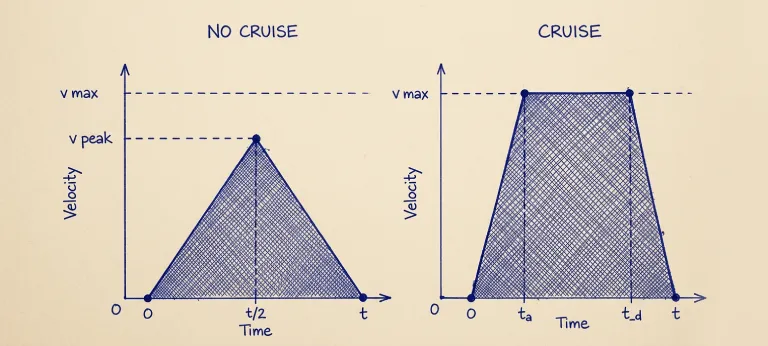 The area under each curve is the distance traveled.
Fragmented movement costs more than continuous movement over the same total distance. Each stop-and-start pays the acceleration-deceleration tax again. Two three-meter advances cost more AP than one six-meter advance.
Movement costs AP (one AP is one second). Time spent moving shifts capacitor position — time that could have been spent recovering toward threshold, or time that pushes further below it.
Reactor
Section titled “Reactor”The Shell’s energy source is a micro-fusion reactor: a pre-Collapse artifact seated deep in the torso, shielded by the same layered composite that protects the rest of the chassis. The reactor fuses deuterium at a slow, steady rate — a trickle of energy, continuous and invariant. It cannot surge. It cannot provide burst output. What it provides is a floor: as long as the reactor has fuel and the containment holds, the Shell does not go dark.
The Operator’s Core is seated inside the reactor’s containment housing. The reactor housing is already the most heavily shielded volume in the chassis — superconducting confinement coils, first-wall materials, layered composite armor above it. Housing the Core inside it collapses two protection requirements into one. The settlement does not need to engineer a second hardened compartment for the one component that matters more than any other. The thing that powers the Shell and the thing that is the Operator share the same armor.
The reactor feeds the capacitor. Every joule the reactor produces flows into the capacitor’s charge. The capacitor is the burst layer — it accumulates reactor output over time and delivers it in the concentrated pulses that drive sinew contraction, coilgun coils, and high-speed movement. The reactor keeps the capacitor fed. The capacitor keeps the Shell fighting.
Destruction
Section titled “Destruction”A Shell is destroyed when its reactor containment is breached. Not when its armor is stripped, not when its sinews are severed, not when its capacitor is drained. A Shell missing a limb, locked at the joints, unable to stand — if the reactor housing holds, the Shell is still “alive”. Everything short of containment breach is damage. The Operator can voluntarily engage the Continuation Protocol at any point — abandoning a damaged Shell before breach forces the choice.
Breach triggers the Protocol automatically. The Operator Continues or the Core extinguishes. The reactor is lost.
Maintenance
Section titled “Maintenance”The Sanctum builds reactors — but the superconducting confinement coil materials (niobium, tin) and plasma-facing components (tungsten, beryllium) must be sourced from GAEA territory. Containment housings are relined in the Basin’s forge, diagnostic interfaces serviced in the Clean Room, seals replaced from the Glassworks. Production rate is limited by precursor supply, not capability.
The reactor consumes deuterium — a hydrogen isotope present in all natural water at roughly 156 parts per million. Extraction is not the bottleneck. Electrolysis and distillation require stainless steel electrodes and glass distillation columns, both within the Sanctum’s material palette. The bottleneck is purity. Fusion is intolerant of contamination. Refining deuterium to reactor-grade fuel demands Clean Room conditions: sealed atmosphere, precision instrumentation, Old World analytical equipment maintained under inert gas. Every hour the Clean Room spends on fuel processing is an hour not spent maintaining Transfer electronics or Shell control systems.
The Sanctum’s deuterium reserve is measured in sorties. The reactor’s consumption rate is low — fusion is extraordinarily energy-dense — but the refining capacity is finite and contested against every other demand on the Clean Room.
Capacitor
Section titled “Capacitor”The capacitor is the Shell’s energy buffer: an internal store that accumulates the reactor’s steady output and delivers it as the concentrated bursts that power movement, combat actions, sensors, and every other Shell function.
Charge and Recovery
Section titled “Charge and Recovery”The capacitor drains as the Shell acts. Between expenditures, the reactor’s trickle replenishes it. Recovery is not constant — the rate at which reactor output is absorbed depends on current charge level.
Recovery follows a two-segment curve with a single peak. It starts at a meaningful base rate when fully drained, climbs to maximum at 38% charge (the threshold), then descends toward zero at full capacity.
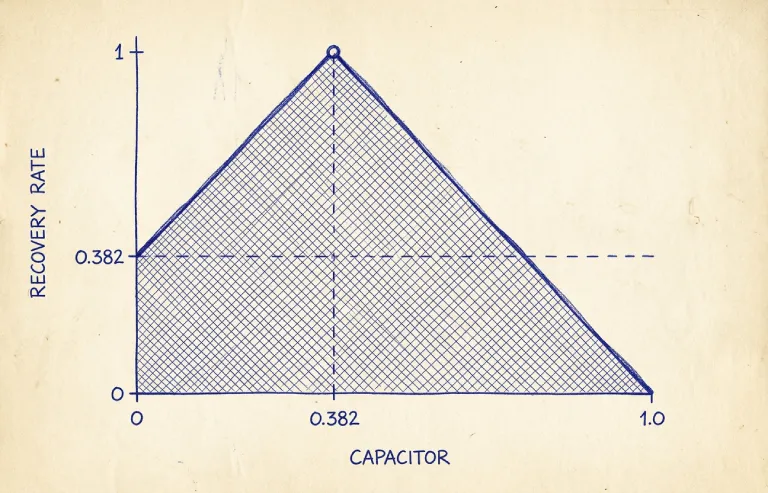
Both segments share the same absolute slope — they are mirror images. Energy spent near the threshold recovers fastest.
Armor is implemented as equipment and not anatomy.
In this world, Shell armor plate is a laminated composite — three layers bonded with silicone adhesive into a single unit. The layers defeat a kinetic penetrator in sequence:
- Strike face — fired ceramic (alumina, silicon carbide, or boron carbide). The hardest layer. Shatters the penetrator’s tip and distributes kinetic energy laterally, sacrificing itself in the process.
- Intermediate — bone ceramic (deproteinized aurochs bone). The trabecular lattice absorbs residual energy through progressive micro-fracture and catches spall from the shattered strike face. The porous structure is infiltrated with silicone oil for additional dampening.
- Backing — metal (stainless steel or titanium). Structural. Catches anything that penetrates both ceramic layers. Prevents deformation into the Shell body beneath.
Plates are worn at the chest, shoulders, outer thighs, and forearms. They are combat consumables: destroyed at the impact site, replaced from the Sanctum’s stockpile of manufactured products.
The Core carries a sensorimotor body schema specific to the biological original (see Character: Body Schema). The phenomenon is well-documented by Transfer specialists: every Core expects to inhabit a particular human form. The face is the primary integration surface — the feature most deeply encoded in the mind’s self-model.
The substrate is bone-derived ceramic — deproteinized aurochs bone, shaped at the Basin to approximate the facial geometry of the biological original. The Transfer specialist provides reference data: the face, the proportions, the structural landmarks of the person who no longer exists. The bone provides the skull geometry that the mind’s self-model expects.
Over the bone substrate, silicone prosthetic skin approximates the original’s appearance. At conversational distance, the face reads as human — a specific human. Under close inspection, the manufactured quality is legible: the texture too uniform, the expression too still, the warmth of the skin not quite matched to the cold of the bone beneath. The face is a compromise between the Operator’s ghost image and engineering reality. It narrows the gap. It does not close it.
Damage at the face is legible as unmasking. Skin torn or abraded reveals the bone beneath — the manufactured substrate visible through the torn human surface.
Overlay
Section titled “Overlay”The Shell’s visual pathway is engineered end to end — optical sensors, processing layer, Core perception interface. The overlay composites system data into the sensor feed before it reaches the Core. Examples:
- Structural integrity
- Capacitor charge
- Distance readings
- Environmental analysis
- Threat classification
Designation
Section titled “Designation”Each Shell bears a designation: the Operator’s name followed by the Shell’s sequence number; RHEA-7, for example. The name belongs to the Core. The number belongs to the Shell and increments with each new chassis. Applied in ceramic enamel — kiln-fired, atmosphere-resistant.
The designation appears on armor, not on the body — one on each shoulder plate,