Weapons
Why Old World Firearms Don’t Exist
Section titled “Why Old World Firearms Don’t Exist”Old World firearms were built from mild steel and polymer. In the elevated oxygen atmosphere of the post-Collapse world, both material classes fail. Mild steel corrodes at dramatically accelerated rates — barrels, actions, and springs degrade beyond function within months of exposure. Polymer components — grips, seals, magazine housings, stock materials — are subject to rapid oxidative decay.
Flechette Rifle
Section titled “Flechette Rifle”The flechette rifle is an electromagnetic coilgun powered by the Shell’s capacitor. Each flechette — a solid metal spike — fills the 7mm bore and is accelerated directly by the coil array. The flechette does its work through mass and velocity alone. Machined fins at the tapered tail provide aerodynamic stabilization within the bore diameter.
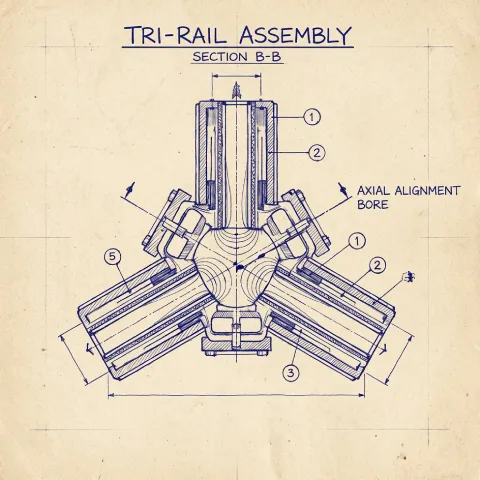
Three barrels, each approaching a meter in length, are arranged in a triangular cluster — two below, one above — giving the weapon a distinctive triangular cross-section. Barrel length is the primary design lever: more electromagnetic coil stages means higher muzzle velocity with less thermal waste per stage. Each barrel contains its own coil array. Total weapon length approaches 1.3 meters. Weight: 14 kg — hardware built for a Shell, not a human.
How It Works
Section titled “How It Works”Each barrel contains a series of electromagnetic coils along its length. The Operator selects a barrel and charges it by drawing energy from the Shell’s capacitor into that barrel’s coil array. The longer the charge is held, the more energy accumulates, and the stronger the magnetic field pulses that accelerate the flechette. Charge time and energy cost are the same physical process.
When the Operator releases, the accumulated charge fires. Muzzle velocity scales with charge time. The energy draw comes from the Capacitor.
Loading
Section titled “Loading”The barrel assembly connects to the receiver via a swivel hinge and latch — the same break-action mechanism as a double-barrel shotgun. The Operator breaks the weapon open, exposing the breech end of all three barrels, and loads one flechette per barrel by hand. The Operator swivels the assembly back into position and latches it. Three rounds in a single motion.
Flechettes are carried in belt pouches, bandoliers, or Shell-mounted external racks.
Ammunition
Section titled “Ammunition”A flechette is a solid, fin-stablized ferromagnetic spike that couples directly with the coil array.
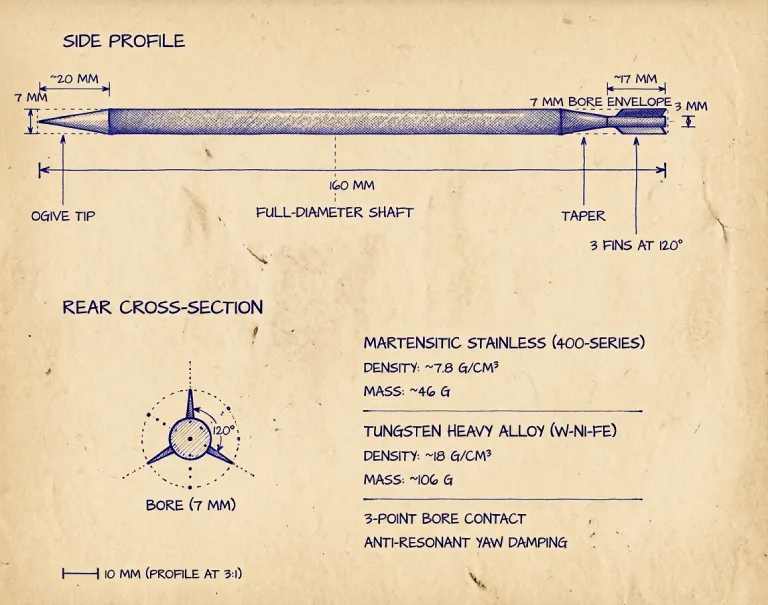
Flechettes are classified in two tiers by material:
-
Tungsten heavy alloy (W-Ni-Fe). Density ~17-18.5 g/cm3. The densest practical projectile material. The nickel-iron binder phase provides ferromagnetism; the tungsten matrix provides mass. Tungsten flechettes do not deform on impact against hardened Shell armor. They punch through. Scavenged from Old World machine tooling, drill bits, mining equipment, and industrial wear components. Supply is rare and small-batch.
-
Hardened martensitic stainless steel (400-series). Density ~7.8 g/cm3. Roughly 45% of tungsten alloy’s mass, delivering measurably less kinetic energy per spike at the same velocity. Ferromagnetic, heat-treatable to extreme hardness. Less corrosion-resistant than the austenitic stainless used for structural work, but adequate for a consumable stored in sealed atmosphere and expended within hours of exposure. The standard round — abundant, forgeable, universal.
The Shell
Section titled “The Shell”A Shell is a weapon. A 100 kg chassis driven by CNT sinew over a stainless steel and titanium frame, moving at a top speed of 40 m/s, delivers 80 kJ of kinetic energy on impact — over four times the muzzle energy of a modern .50 caliber machine gun round.
Momentum Strike
Section titled “Momentum Strike”The Operator commits the Shell to a full sprint into a target. At full speed, the entire mass of the chassis transfers through whatever surface makes contact first. The energy is not concentrated through a point the way a flechette concentrates it. It is distributed across a broader contact area, which means less penetration and more structural deformation.
The cost is borne by both parties. Impact damages the striking surface. Sinew bundles tear under shock loads they were not designed to absorb repeatedly. Joint assemblies deform. Armor plating cracks at stress concentrators.
Standing Strike
Section titled “Standing Strike”A standing strike — a driven punch, a kick, an elbow — uses the sinew to accelerate a limb rather than the whole chassis. The moving mass is smaller (an arm assembly is roughly 12-15 kg), but the actuators can drive it faster than sprint speed over the short acceleration distance of a swing. A hardened forearm moving at 25 m/s through a target delivers roughly 4-5 kJ through a contact area measured in square centimeters. Concentrated force at that scale cracks armor plate, shears sensor housings, and deforms joint assemblies.
Impact Gauntlet
Section titled “Impact Gauntlet”The Impact Gauntlet is worn over the Shell’s hand. An open-finger stainless steel chassis supports an array of removable ceramic plates across the knuckles. The plates are fired alumina seated in recessed rails and held by spring clips. When the gauntlet strikes a hard surface, the ceramic fractures preferentially, absorbing kinetic energy that would otherwise transmit through the chassis to the Shell’s actuators and joint bearings. The Shell’s hand remains functional; the plates sacrifice themselves.
The gauntlet does not amplify force or extend reach. It preserves the Shell’s structural integrity during strikes the Operator would execute anyway. Replacement plates are small, kiln-fired, and clip into the rail in seconds. An Operator who expects sustained melee uptime carries spares.
A removable kinetic penetrator that mounts to the gauntlet’s knuckle line. The spike concentrates force at the target; the plate array behind it disperses the reaction force across the Shell’s hand.
The spike’s base seats into a backing plate that spans the knuckle array. On impact, the reaction force traveling back through the spike spreads across the full contact area of the ceramic plates behind it. The plates fracture progressively to absorb the shock — the same sacrificial mechanism as an unarmed strike, now absorbing the concentrated reaction of a penetrating blow.